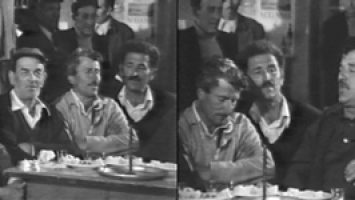


“Musical Travelogue with Domna Samiou” (“Musiko Odiporiko me ti Domna Samiou”) was a television series researched and presented by Domna Samiou and broadcast by Greek National Television in 1976-1977. Each episode was dedicated to the music and dance tradition of a different area of Greece.

Konstantinos Saadedin aka Kerimis performs a lament on his violin accompanied by his son Stavros Saadedin by the lute.
Lament From Epirus With Violin
Konstantinos Saadedin aka Kerimis, violin, Stavros Saadedin, lute. Ioannina 1976
TV program “Musical Travelogue with Domna Samiou”

In the village of Parakalamos, the Chaliyannis family plays the Tsakistos Dance from Pogoni. The musicians are Christos Chaliyannis on the clarinet; Kostas Chaliyannis plays the violin; Vassilis Chaliyannis plays the lute; Thanassis Chaliyannis plays the tambourine.

They also perform a Lament from Epirus On Clarinet
Lament from Epirus on Clarinet
Christos Chaliyannis, clarinet, Kostas Chaliyannis, violin, Vassilis Chaliyannis, lute. Parakalamos, Ioannina 1976
TV program “Musical Travelogue with Domna Samiou”

In Parakalamos village, the 70-year-old Konstantinos Haliyannis (Ntikos) plays his violin and sings the song Lament for Margiola
Rise up Margiola from your grave, from the black soil
Change your fingernails to spades, your palms to shovels…
Lament for Margiola
Konstantinos Chaliyannis (Ntikos). Papaklamos Ioannina 1976
TV program “Musical Travelogue with Domna Samiou”

In the village Ktismata, near the Greek-Albanian border, the Polyphonic Group of Pogoni sings the song Pleasant Company, which tells us about people living far away from their homeland and families.

In the village of Kipi, Christodoulos Tolis aka Litsas sings and plays the song Boulonaseina on the lute and is accompanied by Christos Dervas on the violin. The song is about a raid of the robber Davelis on the village of Skamneli, Zagori.
Boulonasena
Christodoulos Tolis aka Litsas, song and lute, Christos Dervas, violin. Kipi Ioannina 1976
TV program “Musical Travelogue with Domna Samiou”
They also perform the Mistress Phrosyne’s Song.
Mistress Phrosyne’s Song
Christodoulos Tolis aka Litsas, song and lute, Christos Dervas, violin. Kipi Ioannina 1976
TV program “Musical Travelogue with Domna Samiou”

In Ioannina, Grigoris Kapsalis and his group play two dance tunes, Dance from Zagori and I Kleftes (The Bandits).
Dance from Zagori
Grigoris Kapsalis, clarinet, Alekos Chaliyannis, violin, Nikolaos Dervas aka Psaras, lute, Andreas Zoumbas, lute, Michalis Markopoulos, drum. Ioannina 1976
TV program “Musical Travelogue with Domna Samiou”
I Kleftes (The Bandits)
Grigoris Kapsalis, clarinet, Alekos Chaliyannis, violin, Nikolaos Dervas aka Psaras, lute, Andreas Zoumbas lute. Ioannina 1976
TV program “Musical Travelogue with Domna Samiou”

A group of musicians perform the shepherds’ tune Skaros. The musicians are Constantinos Neofotistos playing the clarinet; Stavros Saadedin playing the lute; Constantinos Saadedin aka Kerimis playing the violin; Napoleon Tzichas playing the lute and Mattheos Stavropoulos playing the tambourine.

The same group of musicians perform the song As I Travelled Along the Road sung by Mattheos Stavropoulos.
Credits
Research and presentation: Domna Samiou
Director: Andreas Thomopoulos