

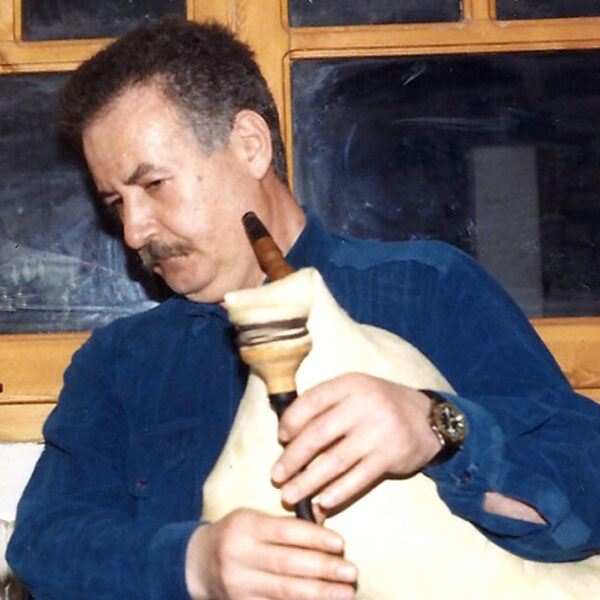
He was born in 1955 in Ladi, Didymoteicho, a village in the region of Evros. He completed primary school in Ladi and attended the six-grade secondary school in Soufli. In his final year there, he constructed his first gaida (bagpipe) with the help of fellow villagers and began teaching himself to play it.
After secondary school, he studied at the Radiology–Radiography Department of the Technological Educational Institute of Athens and, upon completing his military service, was employed at the Ippokration Hospital of Thessaloniki.
During this time, he continued learning and playing the gaida, meeting both renowned musicians such as Chronis Aidonidis and lesser-known ones such as Yannis Strikos. Aidonidis helped him gain a profound understanding of Thracian music, while Strikos introduced him to the Thracian lyra and led him to perform at the Anastenaria rituals.
Over the next thirty years, he collaborated with Domna Samiou, Dionysis Savvopoulos, Ross Daly, and various cultural associations; he travelled abroad, took part in discographic projects, and taught younger musicians what he had learned.
In his later years, he focused more on constructing gaidas and lyras and less on performing, as —according to his own words— many talented young musicians had emerged who played with remarkable skill.
Source: Yannis Dobridis