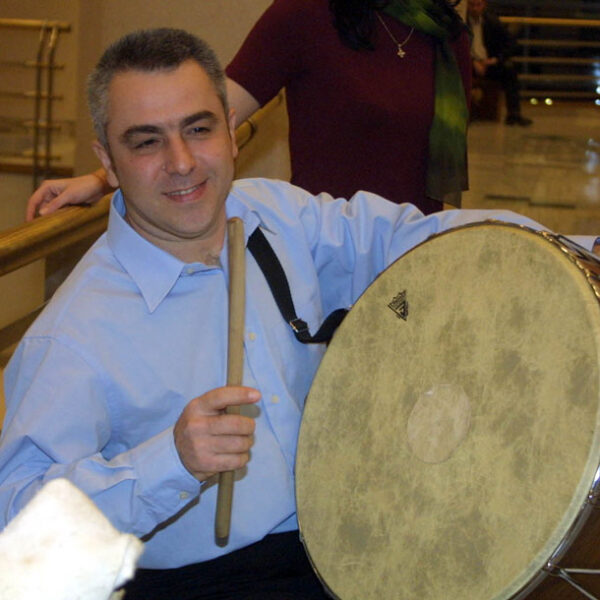
Andreas Pappas

Percussionist — primarily playing davul, toumbeleki, bendir, and defi. He began his musical journey in 1975, participating in traditional orchestras. In 1983, he started collaborating with ERT on television and radio productions, performing alongside prominent musicians of Greek folk music, while also working with leading figures of the Greek music scene.

He has contributed to recordings for theatre and film, performing works by various composers. From 1994 to 1997, he was a member of the State Orchestra of Greek Music (KOEM) under the direction of Stavros Xarhakos. He has collaborated with the Megaron — the Athens Concert Hall on various productions and has participated in international and Greek festivals (WOMAD, Athens Ethnic Jazz Festival, etc.).

In 1995, he released the album “Krousta” in collaboration with Vangelis Karipis and Yiorgos Gevgelis, and in 1997, together with Petros Kourtis and Vangelis Karipis, he founded the percussion ensemble “Krotala”, which performed at festivals and international events. In 2002, he began collaborating with the Estudiantina Orchestra of Nea Ionia, Magnesia.

In 2004, he represented Greece at the International Percussion Meeting in Tunis (MediMuses programme). He participated in the recordings of the music performed at the opening ceremony of the Athens Olympic Games and, in 2008, in the traditional orchestra representing Greece at the Beijing Olympic Games.

Professor of traditional percussion at the Athens Conservatoire.


Source: Andreas Pappas

Songs

Records

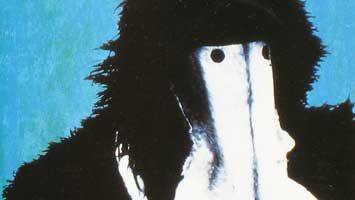
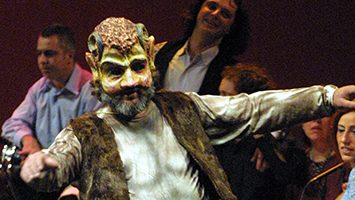
Carnival songs with their ritual bawdiness – ‘sacred in the profane’ – disturbed the prudish devotees of tradition. The recordings come with a detailed booklet analysing the pagan and ritualistic context in which these songs are performed.
These “sacred in the profane” songs of the Carnival with their ritual bawdiness disturbed the prudish “devotees” of tradition. The records are accompanied by a detailed booklet analyzing the pagan and ritualistic context in which these songs are performed.
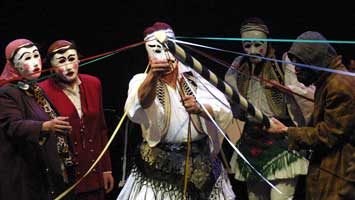
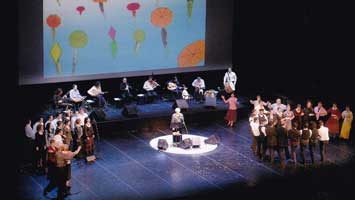
This recorded show includes stage performances of carnival songs and other related popular rituals from different areas of Greece, as they were presented at the Thessaloniki Concert Hall on 2003.
This edition aims to convey the spirit of Easter, the Christian feast celebrated amidst the glory and promise of springtime, through the selected rituals of that period of the year and their related sacred songs and tunes.
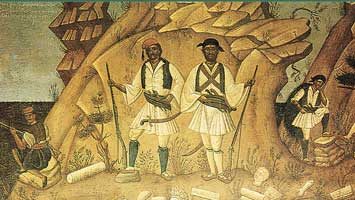
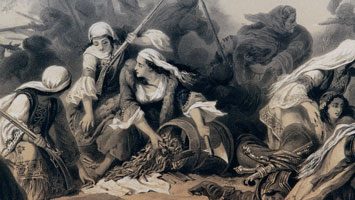
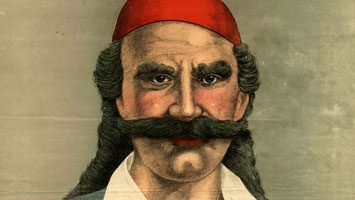
Songs inspired by the popular tradition of story-telling, relating tales of brave warriors, both high-ranked lords, and lowly soldiers. Centering on heroic Digenis, they originate from all parts of Greece.
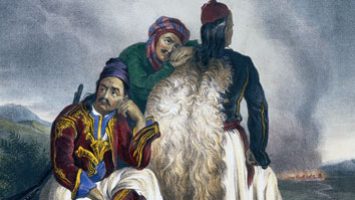
Tales of the fabulous and the fantastic combining the real world with the supernatural. Narrating stories, often tragic, which might once have occurred – or could do so one day.
Includes songs and tunes in “7 beats to the bar” (the rhythm of kalamatianos dances) and in “9 beats to the bar” (the rhythm of zeibekikos and karsilamas dances) with lyrics and melodies both erotic and sorrowful.
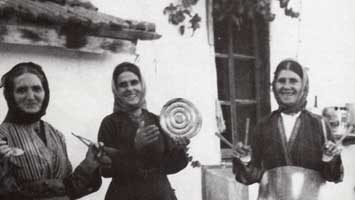
Reissue of the Caprice album “Grekisk folkmusik” (Ξενιτεμένο μου πουλí) on a CD with 9 extra tracks, and a comprehensively informative booklet about Greek folk music and the woman behind this production – Domna Samiou.
The first LP by the state-run ‘Concerts Sweden Rikskonserter’ produced with non-Swedish musicians. Domna Samiou was chosen for her valuable contribution to traditional Greek folk music.
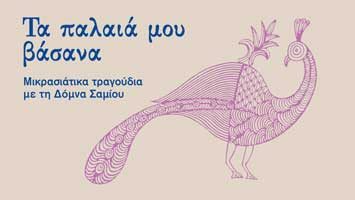
Songs of Asia Minor by Domna Samiou. Live recording from the concert ‘Songs of Asia Minor with Domna Samiou’ at the Megaron, the Athens Concert Hall, on 8/3/2005. Traditional songs from the western coasts of Asia Minor, Propontis, Constantinople, Pontus and Cappadocia.

Concerts

A carnival feast at the stage of the Thessaloniki Concert Hall with songs, dances, and customs of the carnival period. In addition to Domna and her collaborators, musicians, singers, dancers and bands from regions of Greece take part, where even today the celebrations and rituals of Carnival maintain their authenticity.
An Asia Minor tribute concert. A tribute to the muse of the historical space of the Greek East. Traditional songs from the western coast of Asia Minor, the Sea of Marmara, Constantinople, Pontus and Cappadocia and two Byzantine hymns from the musical tradition of the Orthodox Church.