


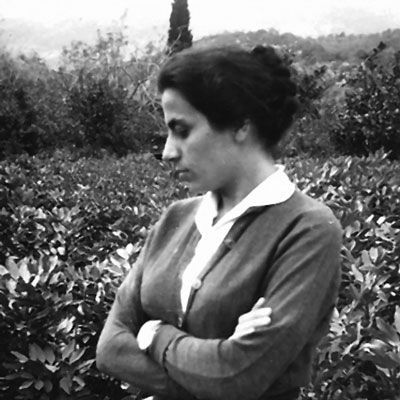
Nea Smyrni, 1960’s
© Domna Samiou Archive
Domna Samiou (12 October 1928 – 10 March 2012) was born in Kaisariani,1 Athens, to parents who were refugees from Baindir, a village in the Smyrna (Izmir) region. Her mother arrived in Greece in 1922, while her father, who had been a prisoner of war, joined the family shortly afterwards through the population exchange.2 Domna spent her childhood amidst the harsh yet supportive conditions of refugee life, where she had her first musical experiences and developed a deep love for traditional Greek music.
At the age of 13, she began her apprenticeship under Simon Karas at the “Association for the Dissemination of National Music”, gaining her first systematic exposure to Byzantine and traditional music. At the same time, she attended evening school.
As a member of Karas’ choir, she began her association with the National Radio Foundation (EIR),3 and in 1954 she was hired by the Department of National Music.4 There she met many leading folk musicians of the time, who had migrated to Athens from different parts of the country. The department recorded these musicians, allowing Samiou to familiarize herself with the full range of local musical traditions, supervise their recordings, as well as the music for theater productions and films.
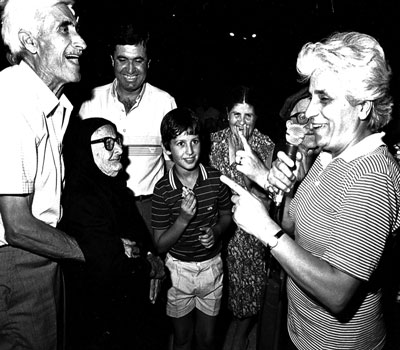
10 July 1983, after a concert
© Domna Samiou Archive
Recognizing that folk music was not being presented as it should be, —following her teacher’s example— in 1963 she began field trips across Greece to collect authentic musical material from people who still remembered genuine songs and melodies.
In 1971, she resigned from the radio and accepted an invitation from Dionysis Savvopoulos to perform at the anti-junta5 “Rodeo” club (see The First Concerts), marking a turning point in young people’s engagement with folk music. That same period included her participation in the English Bach Festival in London, organized by Lila Lalandi, launching her celebrated artistic career.
During this time, she collaborated with record companies and supervised the edition of a series of LPs on traditional music. In 1976–77, ERT commissioned her to film twenty episodes in the Greek countryside for the programme Musical Travelogue with Domna Samiou.
In 1981, she founded the Domna Samiou Greek Folk Music Association to preserve and promote traditional music, primarily through recordings and high-quality events, independent of commercial market pressures. Her work gained international recognition, with albums released in France and Sweden, and she performed concerts worldwide —from Australia to South America— bringing authentic Greek music to the diaspora and international audiences without relying on the bouzouki.
Domestically, she performed countless concerts and events and was honored with numerous tributes, including a commemorative performance in October 1998 for her 70th birthday, The Known and the Unknown Domna, at the Megaron — the Athens Concert Hall.
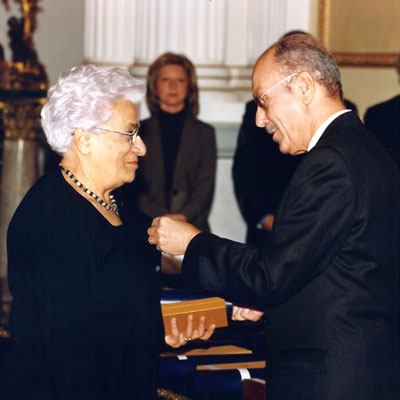
Domna Samiou honored with the Golden Cross of the Order of the Phoenix, 17 January 2001
© Anagnostopouloi Bros.
She collaborated with leading Greek and international musicians, musicologists, and folklorists, mentoring many young artists. From 1993 to 2001, she taught adult folk music courses at the Museum of Greek Folk Instruments in Athens and took initiatives to improve music education for children in primary schools, which she considered a priority.
Her contributions were recognized with many, including the Gold Cross of the Order of the Phoenix, presented by President Konstantinos Stephanopoulos in 2001. Surrounded by collaborators, friends, and supporters, she continued working actively until the end of her life, publishing thematic albums with detailed notes, organizing her personal archive, and updating her website.
Domna Samiou died at the age of 83 on 10 March 2012 after a brief illness. Her funeral, attended by a large public, took place at the Nea Smyrni Cemetery. In 2023, the Hellenic Parliament Foundation for Parliamentarism and Democracy organized an event in her honor, celebrating her life and work.
1The neighborhood of Kaisariani, to the east of central Athens, is one of the many neighborhoods established following the influx of Greek refugees from Turkey in 1922.
2The compulsory, large-scale population exchange between Greece and Turkey in 1923, which followed the cessation of hostilities between the two countries in 1922.
3EIR: The state-run national radio station of Greece.
4Specifically, the folk music section of EIR.
5Junta: The military dictatorship that ruled Greece from 1967 to 1974.